
India's permanent membership in the reformed UNSC is unacceptable to Pakistan
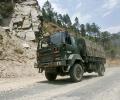
It is learnt that Defence Minister Rajnath Singh has conveyed to top military brass that there was no need for reviewing the implementation of any of the key projects along the Line of Actual Control (LAC) in Ladakh, Sikkim, Uttarakhand or in Arunachal Pradesh in view of the aggressive behaviour by Chinese troops in several sensitive areas.
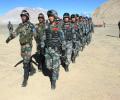
Indian and Chinese troops remained engaged in an eyeball-to-eyeball situation in several disputed areas.
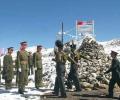
People familiar with the situation in the region said the two sides were engaged in trying to resolve the dispute, but there was no indication of a positive outcome yet as both the armies continued to bolster their positions in disputed areas of Pangong Tso and Galwan Valley and Demchok.

The EU India summit is likely to endorse India's position on bilateral talks with Pakistan on Kashmir.
It is learnt that the India's top military brass is constantly monitoring the evolving situation even as the United States said the aggressive behaviour by Chinese troops was a reminder of the threat posed by China.

The minister said the terrorist groups created by Pakistan is not only harming India, but also hurting its neighbours.

He said his country will take all steps to 'expose' India's role in the break up of East Pakistan in 1971 and to 'destabilise' it through terrorism.
"Are they ready to review their decisions? If they do, we can also review our decisions. Review will be on both sides," Qureshi said.

Modi conveyed to Sharif India's decision to release detained Pakistani fishermen on the pious occasion of Ramzan.
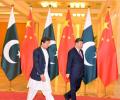
Both leaders also exchanged views on the situations in South Asia, an official Chinese statement said about the meeting between Xi and Khan.

Chinese President Xi Jinping arrived in Ahmedabad on Wednesday to a grand welcome. He is India on a three-day visit which will focus on significantly ramping up trade and investment, besides addressing the contentious border issue that has seen occasional flare ups between the two Asian giants.
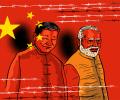
The reasons for China's negative response are located in its territorial dispute with India but also to its grand designs of dominating the region from its previous position of being merely a "balancer" between India and Pakistan, points out Srikanth Kondapalli, Professor in Chinese Studies at JNU.
The Pakistani president, however, said tension between the two countries will subside only if the Kashmir issue was resolved.
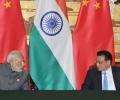
Modi, while addressing students at the Tsinghua University in Beijing, asserted that India and China face instability in their 'shared neighbourhood' that can threaten the security and slow down the economies of the two countries.

Our desire for good neighbourly relations with India has not been reciprocated, said Pakistan PM Nawaz Sharif.

'They are aware that they have been unable to bring about any change in the security situation in Kashmir and have failed to internationalise the Kashmir issue.'

Imran said the previous Pakistani governments "should not have pledged what they could not deliver."

Nevertheless, border dispute will feature prominently on Modi's agenda but the matter won't be discussed at length. Nayanima Basu reports
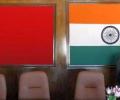
As the border standoff entered the sixth month, an early resolution to the row appeared dim with close to 100,000 Indian and Chinese troops remaining deployed in the high-altitude region and showing readiness for a long-haul. There is no official word on the talks yet but sources said the agenda was to finalise a roadmap for disengagement of troops from all the friction points.
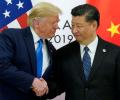
"We are capable of properly resolving the issues between us through dialogue and consultation. We do not need the intervention of the third party", he said.
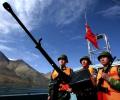
The Chinese side has particularly bolstered its presence in the Galwan Valley, erecting around 100 tents in the last two weeks and bringing in heavy equipment for construction of bunkers, notwithstanding the stiff protest by Indian troops. There have been reports of multiple incidents of transgressions by Chinese troops in several areas in Eastern Ladakh.
Both the Indian and Chinese armies have brought in more troops in sensitive locations like Demchok, Daulat Beg Oldie and areas around Galwan river as well as Pangong Tso lake in Ladakh, the sources said. The area around Galwan has been a point of friction between the two sides for over six decades.

Until Delhi and Beijing resolve outstanding border issues within an accelerated time frame, standoffs like Doklam will be repeated across various peaks along the Himalayas, says Mathew Maavak.
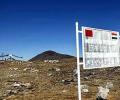
Prime minister likely to visit Beijing, Shanghai; also President Xi's home province, Shaanxi. Nayanima Basu reports

The two PMs called upon all countries to work towards rooting out terrorist safe havens and infrastructure.
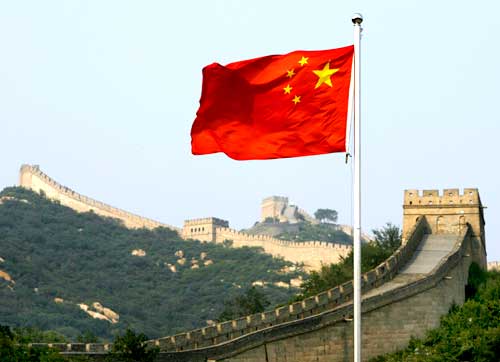
Describing the boundary talks with China as "positive", National Security Adviser Ajit Doval on Friday said India has inalienable positions and the government will protect vital national interests.
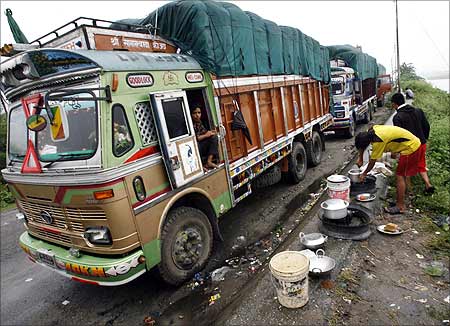
Nepal's Cabinet on Monday passed a special resolution asking India to open the border entry points to ease supplies of essential goods like medicines, gas and petroleum to the landlocked country, reeling under acute shortage due to blockade of key trade points.
Trump aides, who participated in the two-day talks held at the US President's Mar-a-Lago resort in Florida, described the meetings as productive and said the two leaders exhibited "positive" chemistry.

The conference was attended by envoys of Pakistan posted at Washington, Beijing, New Delhi, Afghanistan, UN New York, UN Geneva, Vienna, Brussels and Moscow among others.

Thanks to the recapitalisation by the government and measures taken by the central bank, collapse of any large housing finance company won't pose as big a risk as it had six months ago.
'Relations between India and Japan are robust and devoid of either shadow of history or any irritant.' 'In fact, there is plenty of warmth and goodwill earned over history. There are no negatives but only opportunities,' notes Dr Rajaram Panda.

Hardening its stance further, India has once again virtually rejected Pakistan's latest invitation for talks on Kashmir.

"It would be wonderful if they (India and Pakistan) get along," Trump said.
'New Delhi feels that given the internal dynamics in Pakistan and the overwhelming powers wielded by the army, one will have to wait for better times to see any meaningful progress in the India-Pakistan relationship,' says Ambassador G Parthasarthy.

Pakistan's Foreign Office spokesman Nafees Zakaria said in a statement that Indian High Commissioner Gautam Bambawale was called to hand over a letter of invitation for talks.

Sri Lanka's new president will embark on a 4-day visit to February 15.

The new data comes a day after China and the US signed a long-awaited phase one deal, marking a ceasefire in the 18-month-long trade war which saw the world's two largest economies slap 25 per cent tariffs on about half a trillion-dollar worth of each other's exports. The world's second-largest economy grew by 6.1 per cent last year, its worst performance since 1990, but it remained above the psychologically important mark of six per cent, according to the National Bureau of Statistics (NBS).
